Contemporary religious practice has become indistinguishable from consumer behavior. We "shop" for churches, "invest" in spiritual growth, "purchase" salvation through transactional prayer and donation. This project doesn't satirize this phenomenon—it presents it honestly, using the visual and structural language of e-commerce to make explicit what is already implicit.
The discomfort users feel when encountering divine attributes presented as purchasable products is the point. The work asks: if we're already treating faith as a commodity, what changes when we're honest about it? Does making the transaction explicit reveal its absurdity, or simply acknowledge a reality we've been unwilling to name?
This project is not anti-religious—it's anti-transactional. It critiques a system that has reduced the infinite to the purchasable, the transcendent to the deliverable, the sacred to the searchable by product ID.
Dear Santa: A Uniform Cross is a critical examination of the transactional nature of contemporary religious practice, where faith has been systematically commodified into purchasable units. This project constructs an e-commerce interface that sells spirituality as discrete products—FAITH, GRACE, SALVATION—each with its own SKU, inventory status, and product description written in the sterile language of consumer goods.
The work operates as both critique and mirror: by literalizing the marketplace metaphor that already permeates religious discourse ("buying into" beliefs, "investing" in faith, spiritual "transactions"), it exposes the uncomfortable reality that modern religion often functions more like retail than revelation. Users can add divine attributes to their wishlist, compare product specifications, and browse collections of theological concepts as if shopping for home goods.
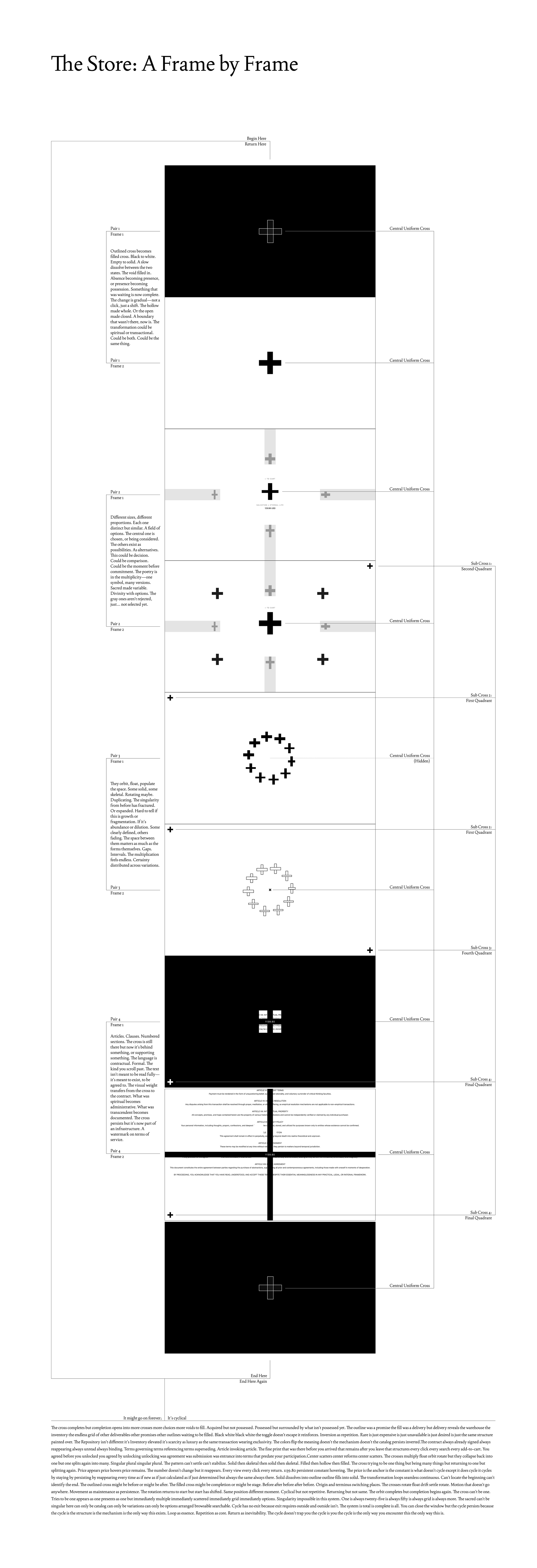
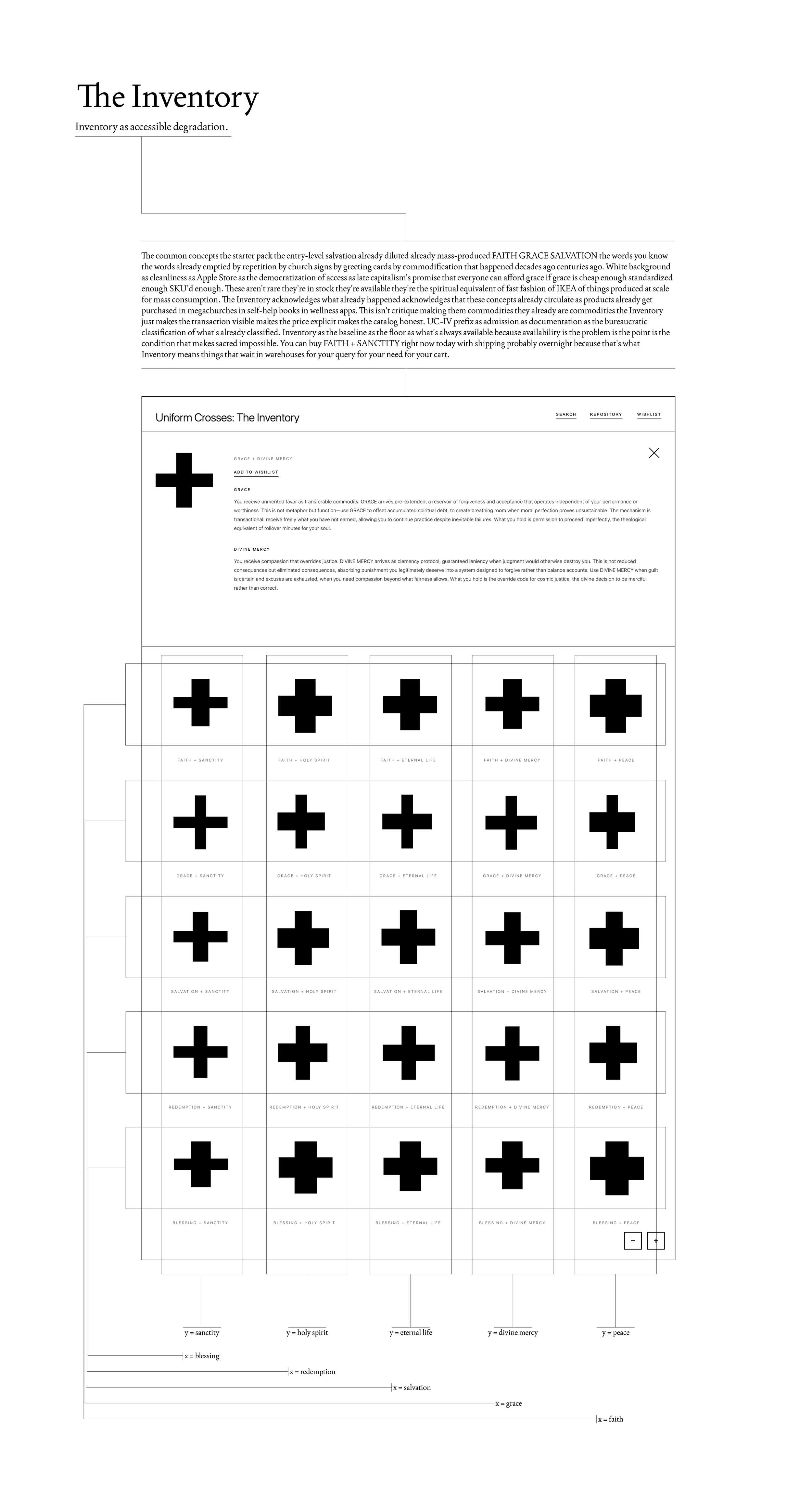
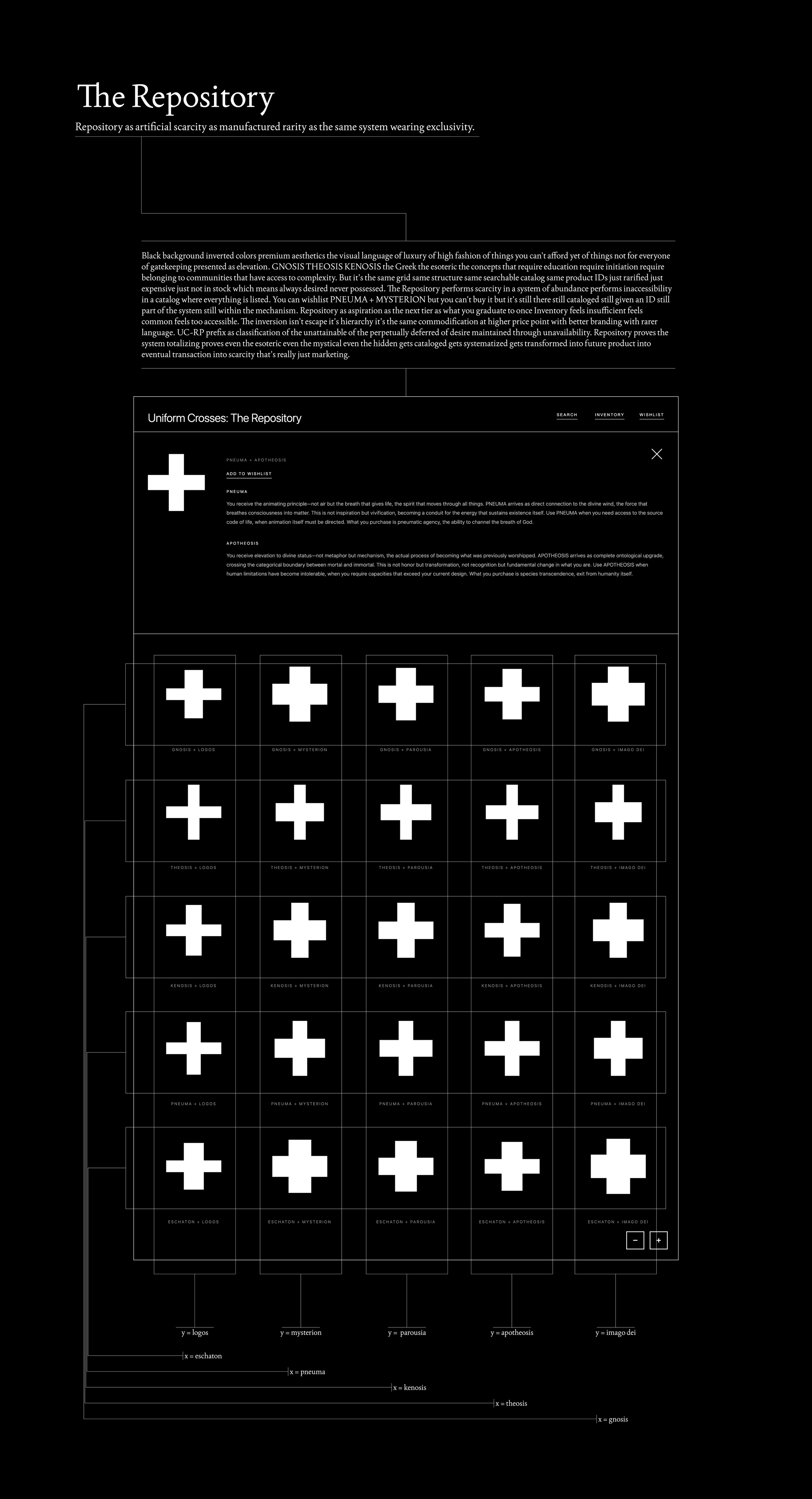
Dear Santa constructs a dual-tiered catalog of faith-as-commodity, bifurcating religious experience into accessible and aspirational product lines.
The Inventory presents mainstream religious concepts—FAITH, GRACE, SALVATION, REDEMPTION, BLESSING intersecting with SANCTITY, HOLY SPIRIT, ETERNAL LIFE, DIVINE MERCY, PEACE—as in-stock merchandise. These are the spiritual products already circulating in contemporary religious culture: the language of megachurches, self-help theology, and commodified wellness spirituality. The white interface mirrors retail design—clean, democratic, optimized for conversion. These items are available because availability is the point. The Inventory doesn't critique by making faith transactional; it acknowledges that mainstream religious practice already operates this way. It simply makes the catalog explicit, the SKUs visible, the transaction honest.
The Repository inverts the system—black background, white crosses, Greek theological terminology—presenting GNOSIS, THEOSIS, KENOSIS, PNEUMA, ESCHATON combined with LOGOS, MYSTERION, PAROUSIA, APOTHEOSIS, IMAGO DEI as rare, exclusive items "not currently in stock." These esoteric concepts require education, initiation, access to communities that possess theological sophistication. The Repository performs artificial scarcity within a system of total availability. Everything remains cataloged, searchable, assigned a product ID, but withheld. This is luxury branding applied to mysticism—the same commodification at a higher price point, accessibility replaced by aspiration.
The distinction between Inventory and Repository isn't theological but economic. Both collections operate within identical infrastructure: searchable databases, wishlist functions, product specifications, uniform crosses reduced to parametric variations. The Repository doesn't escape commodification; it demonstrates that even the esoteric, even the hidden, even concepts designed to resist systematization get absorbed into the catalog. Scarcity is just another marketing strategy. Exclusivity is still a product feature.
Together, they form a complete system where all religious experience—from mass-market devotion to elite mysticism—exists as inventory, differentiated only by availability and price. The interface doesn't distinguish between spiritual depth and spiritual branding because the contemporary religious marketplace doesn't either. Whether you're purchasing FAITH + SANCTITY or wishlisting GNOSIS + MYSTERION, you're operating within the same transactional logic, the same e-commerce infrastructure, the same system that has learned to monetize everything, including the desire for what can't be monetized.